TL;DR: Incentivized demo ads offer a reward, usually a $100 Amazon gift card, in exchange for a qualified sales meeting. They work best on warm accounts that already know you, and for companies with high contract values or high close rates. Run them as one-to-one Message Ads alongside a strong brand awareness program, keep the copy short, require a phone number, decline bad fits before the call, and only send the reward after the demo happens.
Most B2B buyers will never raise their hand for a demo on their own. Not because they aren’t interested, but because a sales call feels like a commitment, and there’s always something more urgent on the calendar.
Incentivized demo ads give those buyers a reason to say yes today. Done right, they are one of the most efficient pipeline plays on LinkedIn. Done wrong, they fill your sales calendar with gift card hunters.
We’ve run millions of dollars in LinkedIn ad spend behind incentivized demo offers at Speedwork Social, profitably. This guide covers exactly how we do it: who it works for, how to target it, the copy that converts, how to protect against fraud, and the templates you can copy.
What are incentivized demo ads?
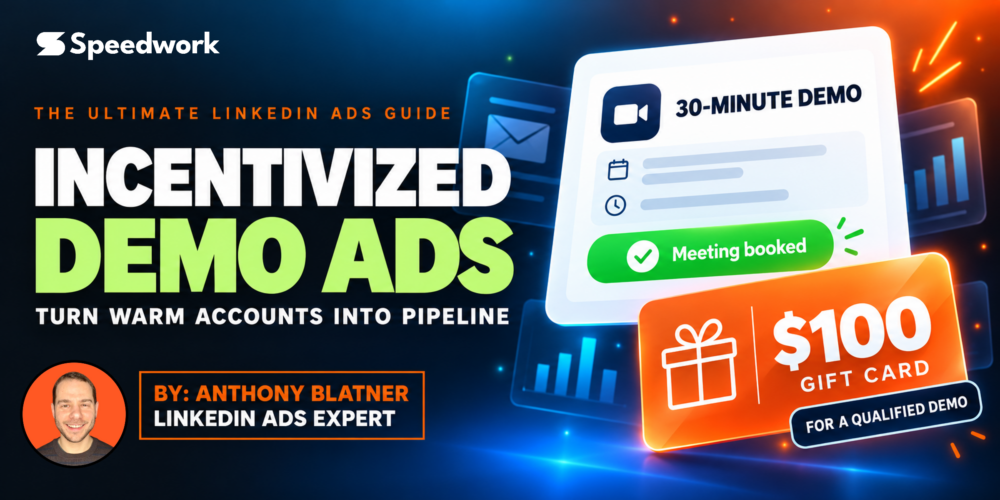
An incentivized demo ad is a LinkedIn ad that offers a reward in exchange for taking a sales meeting. The most common version is simple: “Take a 30-minute demo and we’ll send you a $100 Amazon gift card.”
The reward isn’t a bribe to buy. It’s a thank-you for the buyer’s time, and it gives a warm prospect the nudge to book the meeting they were already considering.
Here’s what it looks like in the wild. Ramp, the corporate card and spend management company, runs the same $100 gift card offer two ways on LinkedIn: as a single image ad in the feed, and as a Message Ad sent from a real person on their team.
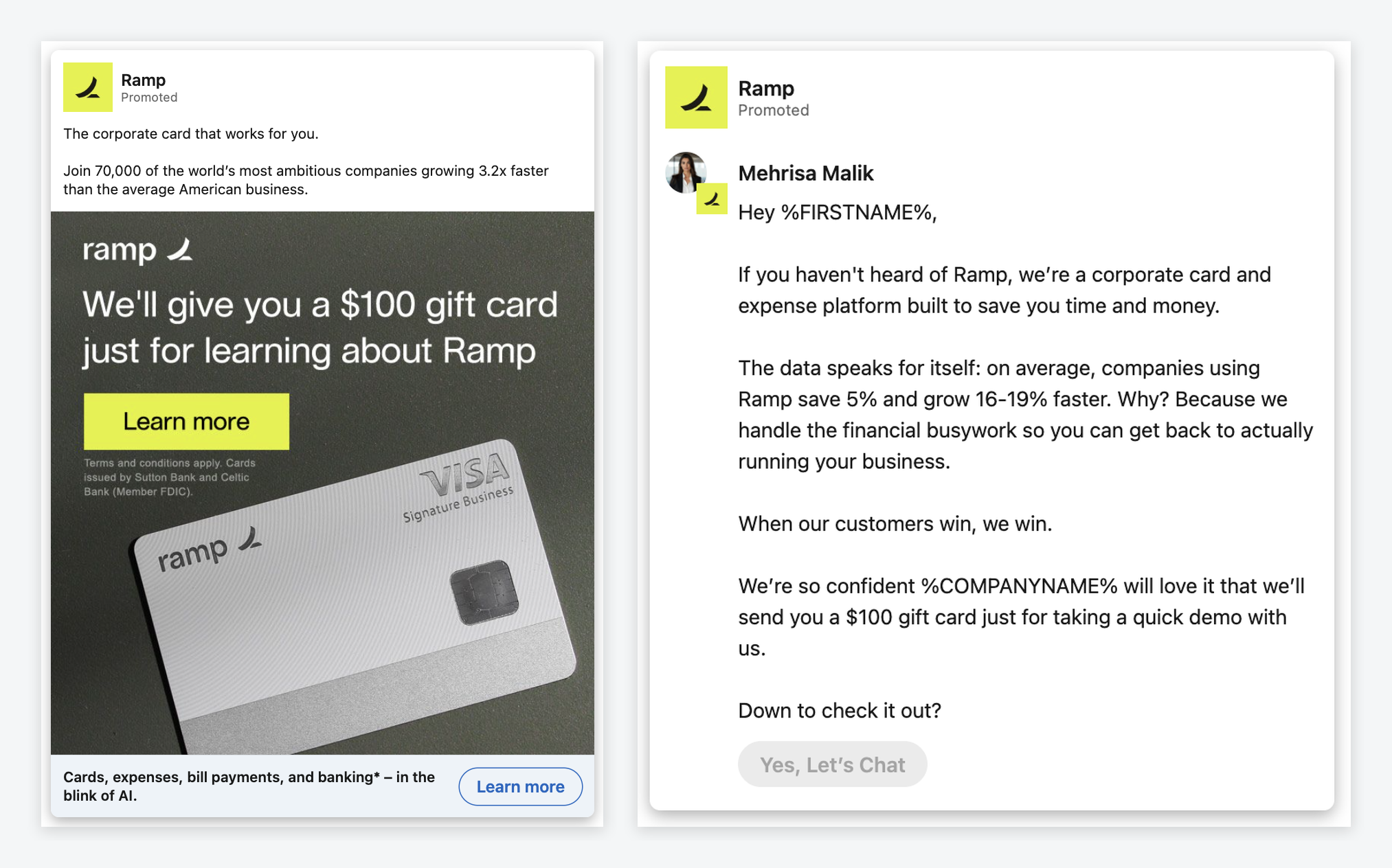
Ramp’s incentivized demo offer as a feed ad (left) and a Message Ad (right).
Notice what both ads do well: the offer is impossible to miss, the copy is short, and there’s one clear ask. Also notice that Ramp has enormous brand awareness, which is why it can run the offer publicly in the feed. For most B2B brands, we recommend keeping the offer inside one-to-one Message Ads (more on that below).
Do incentivized demo ads work?
Yes, for the right companies and the right audiences. In our experience, they’re the fastest way to get prospects on a call, and they have the highest show-up rate of any meeting source (shocker). The catch: they don’t work for everyone, and they’re easy to mess up. Here are three recent results from accounts we manage:
| Company | Play | Ad spend | Pipeline | Result |
|---|---|---|---|---|
| Enterprise SaaS | Target account list, Q1-Q2 2026 | $96,189 | $3,963,785 | 41x pipeline to spend |
| HR software | Competitor conquesting, last 2 years | $150,723 | $6,827,544 | 45x pipeline to spend |
| New AI product | Product launch | $33,108 | $1,670,000 | 50x pipeline to spend, 77% of meetings converted to trial |
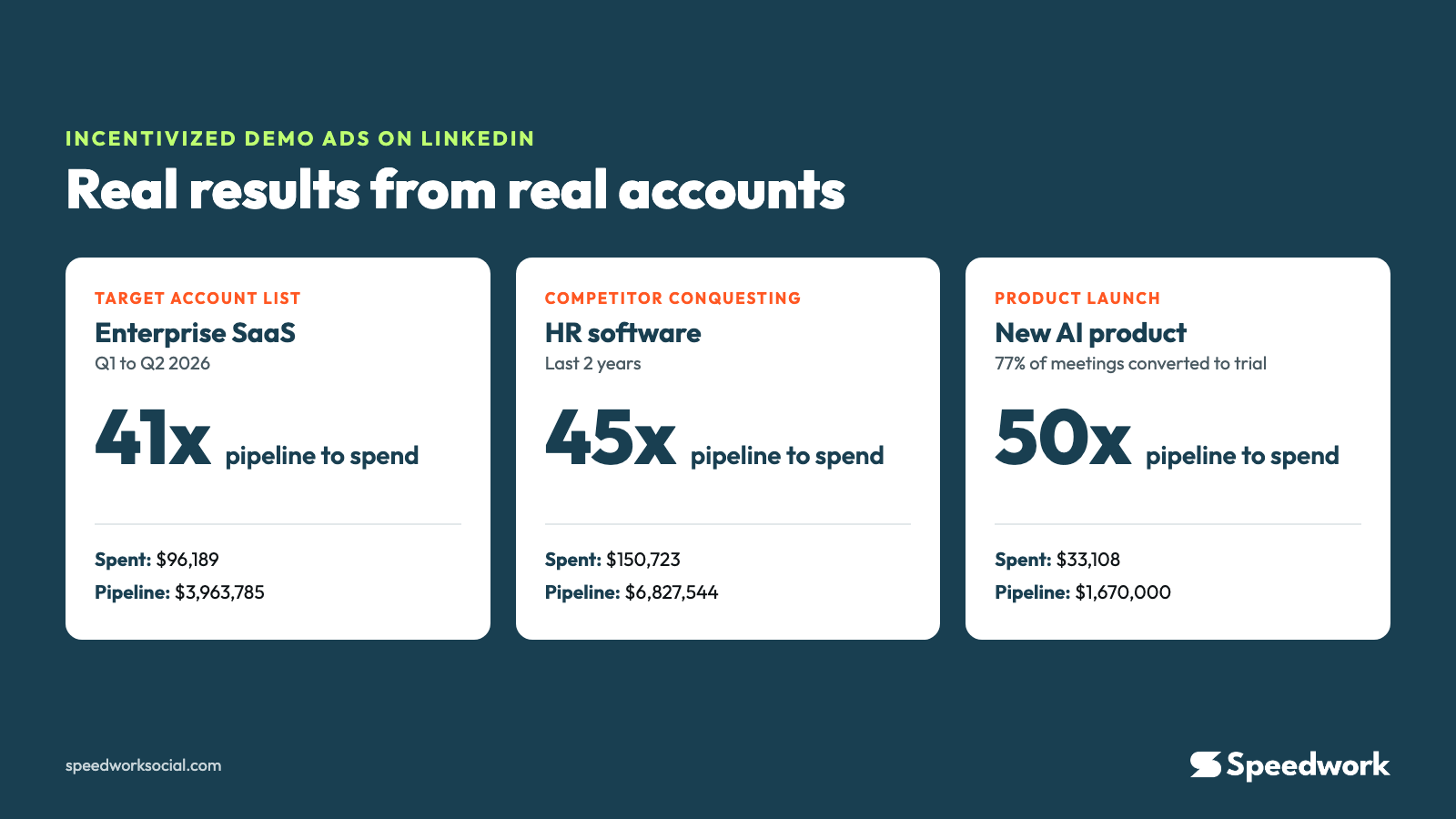
The enterprise SaaS company had a specific target account list, and their sales team simply wanted more at-bats with those accounts. They spent about $96K on incentivized demo ads and generated almost $4M in pipeline.
The HR software company ran competitor conquesting. We built campaigns competitor by competitor, targeting people at companies using each competing product, and generated a 45x pipeline-to-spend ratio over two years.
The AI company was launching a new product. Buyers were curious but hadn’t seen it yet. The incentive got them into the meeting for under $100 each, and 77% of those meetings converted into a product trial. In total, $33,108 in ad spend generated $1.67M in pipeline, a 50x pipeline-to-spend ratio.
Not every meeting needs to become a deal
Some of the most valuable incentivized meetings never turn into an opportunity on their own.
An enterprise supply chain analytics company ran incentivized demos to a tight list of global enterprise accounts, and landed meetings with stakeholders at Apple and Nvidia. Those meetings didn’t lead to a direct opportunity. But the people they met helped them map out how each organization actually works: who owns the decision, who influences it, and who to talk to next.
That gave them insight into, and a foothold inside, two of the hardest accounts on their list. On enterprise target accounts, a meeting that maps the org can be worth as much as one that turns into pipeline.
Who should use incentivized demo ads?
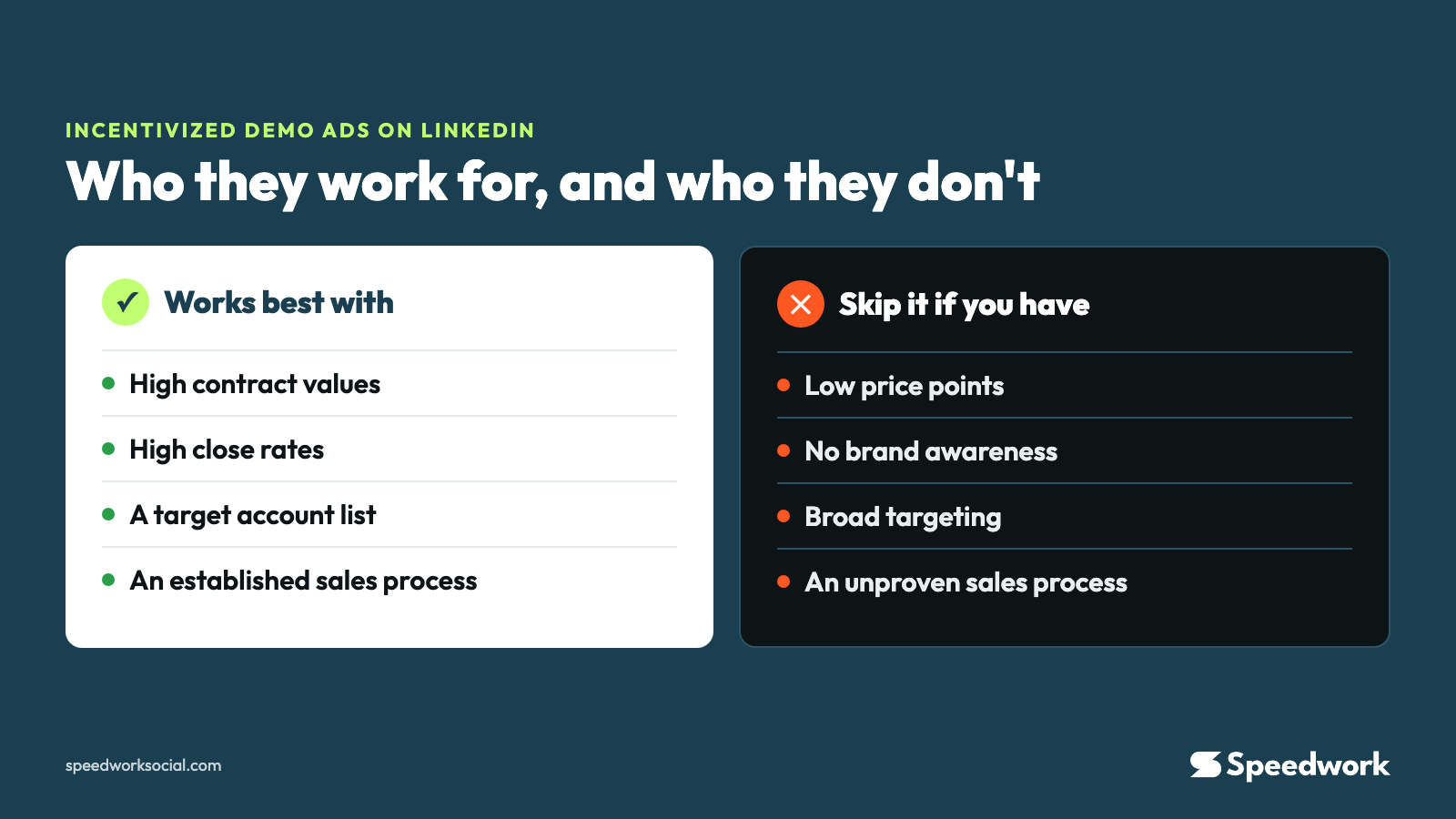
Incentivized demos work best for two types of companies:
- High contract values. Enterprise software, where one closed deal is worth tens or hundreds of thousands of dollars. A $100 gift card is a rounding error against that.
- High close rates. New or differentiated products, like AI tools, where buyers who actually see the product tend to convert.
The math is what makes it work. Here’s an illustrative example: if your average contract is $50,000 and you close 20% of qualified demos, every qualified demo is worth $10,000 in expected revenue. Spending a few hundred dollars in ads plus a $100 gift card to get one is an easy trade.
They also work best when you have:
- Active demand for what you sell, so the demo itself is a high-converting offer
- An established sales process and sellers you trust to run a great call
- Established brand awareness with the audience you’re targeting
- A new product or service to launch, where buyers are curious but haven’t seen it yet
And they shine in one specific situation: you have a very specific target account list, and your sales team just wants more at-bats with it. When sales already knows exactly who they want to talk to, an incentivized demo is the most direct way to get those meetings on the calendar. Our podcast episode on mastering ABM with LinkedIn Ads covers how to build and work that list.
Don’t run them if you have low brand awareness with the audience, or you’re not confident in your sales process or your sellers. The incentive gets people into the meeting. If the meeting itself isn’t great, you’ve just paid for a bad first impression.
They also usually don’t work for low contract values or products with low demo-to-close rates.
When to run them: warm accounts, not cold traffic
This is the most important rule in the guide. Incentivized demo ads are a closer, not an opener. It’s the 95-5 rule in action: only a small share of your market is ready to buy at any given time, so save the incentive for the accounts that are already warm.
The ideal reaction to your ad is: “Oh, I’ve been hearing a lot about you,” or “I’ve been meaning to check out a demo.” The gift card isn’t creating the interest. It’s getting someone who’s already interested over the line.
Run them to warm audiences, such as:
- Website visitors from the last 90 to 180 days
- People who watched your video ads or engaged with your Thought Leader Ads
- Lead Gen Form openers who didn’t submit
- Target accounts that have engaged with your ads over the last few months
- Company Page followers in your ICP
If you send a gift card offer to a cold audience, you’ll get leads. They just won’t be buyers.
Will incentivized demo ads hurt our brand?
It’s the first objection we hear, and it’s a fair one. Nobody wants their brand to look like it’s paying for attention.
Two things keep the brand safe:
- Send the offer only through one-to-one Message Ads. The offer lands privately in a prospect’s LinkedIn inbox, from a real person. It never appears as a public post in the feed, so the broader market doesn’t see your brand handing out gift cards.
- Pair it with a heavy brand awareness effort. Incentivized demos should sit at the end of a funnel that’s already building your reputation with Thought Leader Ads, video, LinkedIn Events, and educational content. The brand work earns the trust. The incentive just converts it. For the full brand-building playbook, listen to our Ultimate Thought Leader Ad Playbook episode.
Run this way, prospects experience it as a personal invitation from someone they’ve already been hearing from, not a gimmick. In our experience, it hasn’t hurt brand perception for the companies running it.
Step 1: Tighten your targeting and exclude bad fits
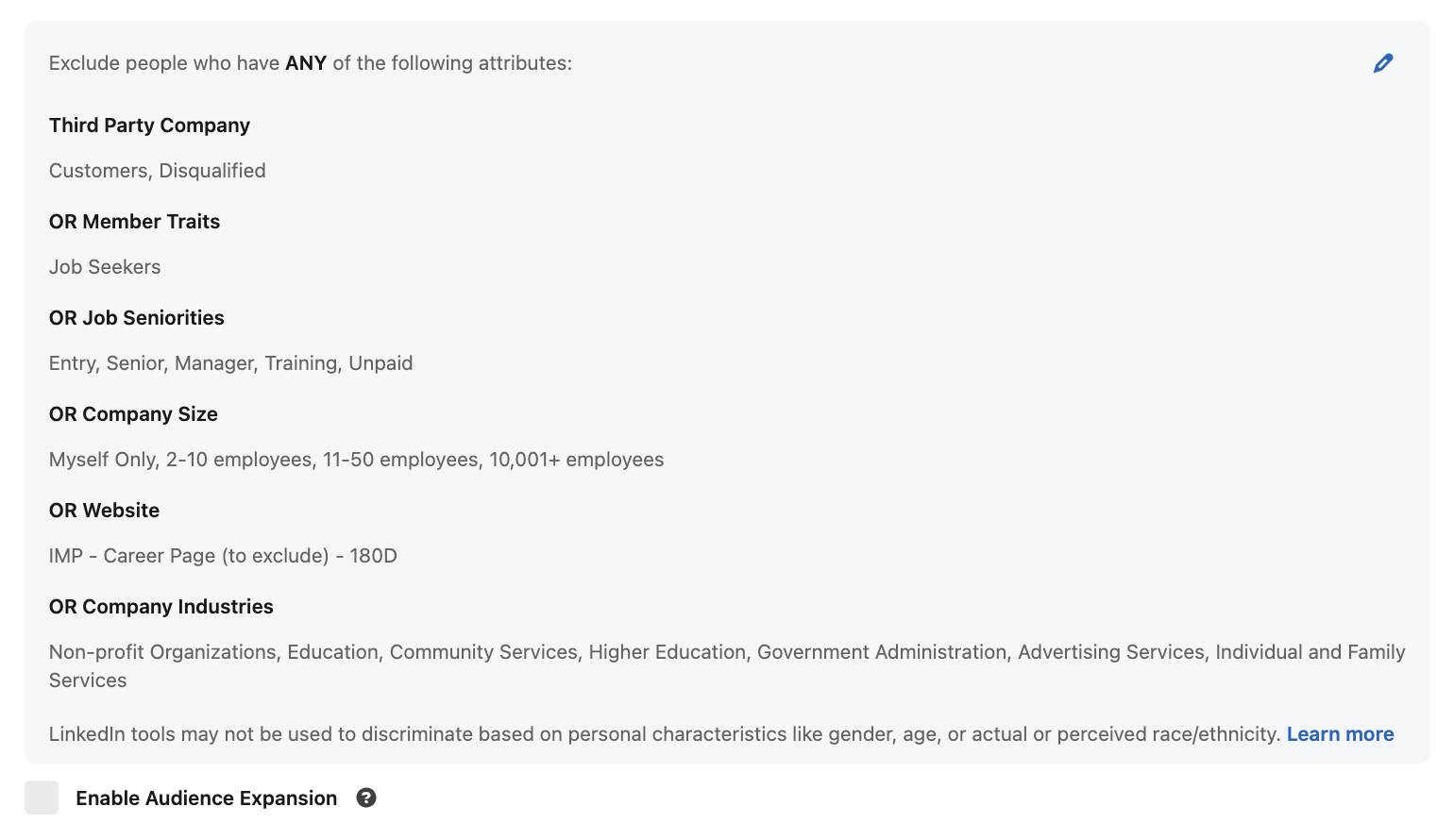
Because there’s money on the table, your targeting needs to be stricter than usual. Every unqualified person who sees the offer is a potential bad meeting.
- Narrow job titles or functions plus seniority to the people who actually evaluate your product.
- Set company size and geography to your real ICP.
- Exclude current customers, competitors, your own employees, partners, open opportunities (unless you’re targeting them on purpose), and entry-level seniorities.
- Exclude agencies and consultants if they aren’t buyers for you.
- Turn off Audience Expansion and the LinkedIn Audience Network. Both widen your reach to people you didn’t choose.
Step 2: Use one-to-one Message Ads
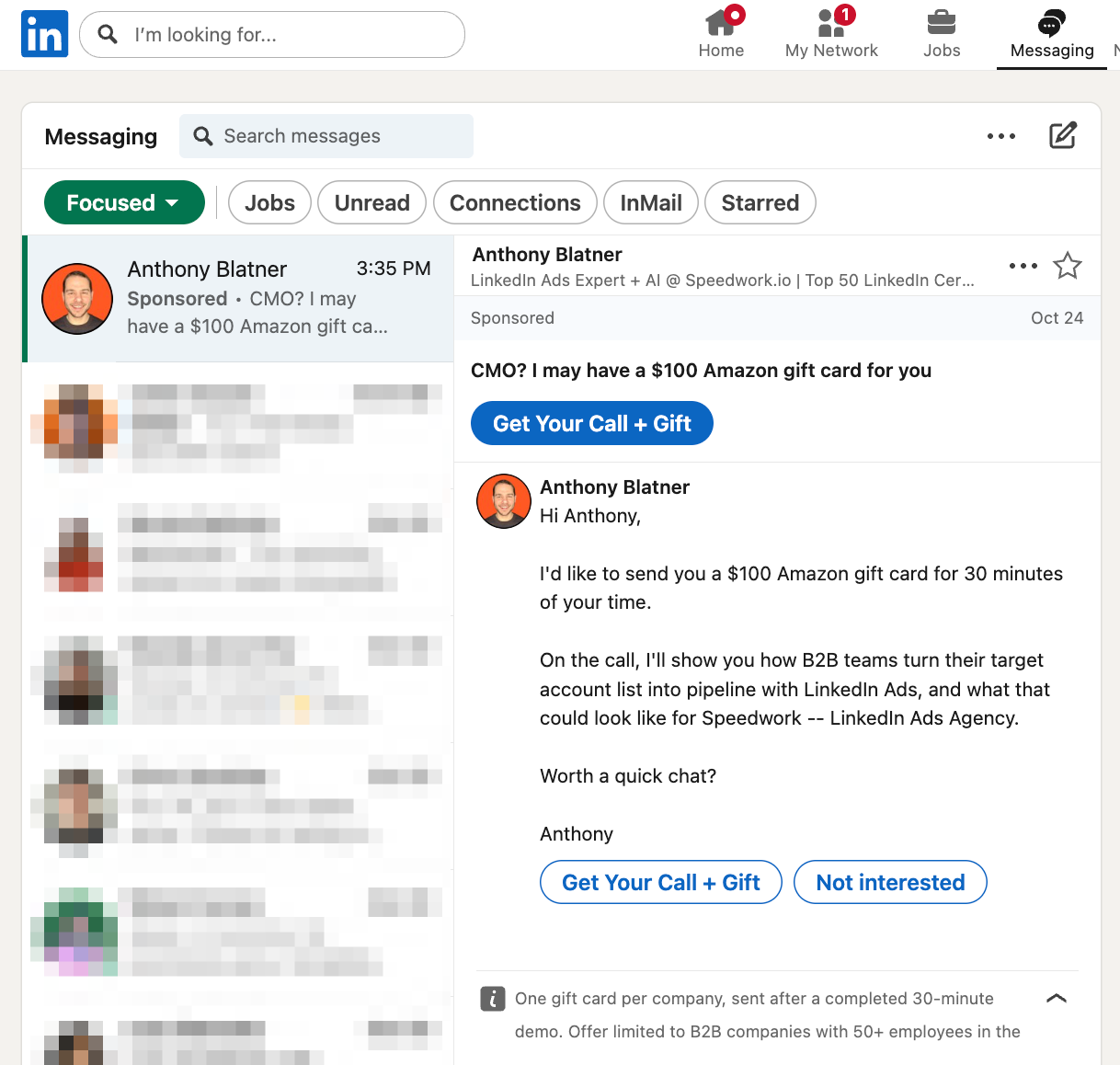
We run incentivized demo offers as Message Ads only. The offer lands in the LinkedIn inbox from a real person, usually a founder, sales leader, or the AE who will run the demo. It reads like a personal invitation, not a banner ad, and it keeps the offer out of the public feed. New to the format? Read our complete guide to LinkedIn Message Ads, or listen to our podcast episode on mastering Sponsored Message Ads.
Attach a LinkedIn Lead Gen Form to the Message Ad, so the prospect never leaves LinkedIn to book.
The sender matters a lot. The same offer can perform very differently depending on who it comes from. Choose a sender whose voice is warm and friendly, never stern or cold. In our accounts, messages from women have usually outperformed messages from men, and bright, clear, welcoming profile pictures win, so test your sender like you’d test any other variable. If a teammate is your sender, here’s how they can accept the sender request.
Step 3: Keep the copy short, direct, and clear
The best-performing incentivized demo copy follows the same pattern:
- Put the offer in the subject line. Don’t make people read three paragraphs to find out there’s a gift card.
- Keep it to 75 to 150 words. One problem, one proof point, one offer, one ask.
- Make the trade explicit. “Take a 30-minute demo and we’ll send you a $100 Amazon gift card.”
- Write like a person. First person, first name, no corporate voice.
- Close with one short question. “Interested?” or “Worth a quick chat?”
In one account, the short version (“Sick of [problem]? Get a $100 gift card”) drove leads at less than half the cost of longer, softer versions of the same offer. Short wins.
Step 4: Pick the incentive
A $100 Amazon gift card is the most common incentive, and the easiest place to start. It’s universal, easy to fulfill, and everyone understands the value instantly.
Targeting executives at large or premium companies? Raise the incentive. A $100 gift card can feel small to a VP or C-level buyer at an enterprise. For those audiences, test $175 or $250, or even more for very senior buyers or very large deal sizes.
Personalize the offer to your audience when you can. A charity donation works well when you’re targeting nonprofits. One employee health and wellness platform offered World Cup jerseys instead of gift cards. The more the reward fits your brand and your buyer, the more it feels like a gift and the less it feels like a transaction.
Once your baseline is working, split test other rewards:
- A donation to the prospect’s favorite charity
- AirPods
- An iPad
- An on-brand gift that fits your product or audience
Some buyers can’t accept personal gifts because of company policy. A charity donation option often unlocks those buyers, so it’s worth testing.
Step 5: Build the lead gen form (and require a phone number)
Most of the time, we tell clients to keep lead forms as short as possible. Incentivized demos are the exception.
This is the time to require a phone number. It adds just enough friction to filter out low-intent submissions, and it gives your sales team a direct way to reach every lead fast.
Your form should include:
- First name, last name, work email, phone number (required)
- Job title and company name
- One qualifying question, like company size or current tool
- The qualifications for the offer, listed right in the form, so people know up front whether they’re eligible
- A destination URL that sends them to your calendar booking page after they submit, so they can book the demo themselves right away
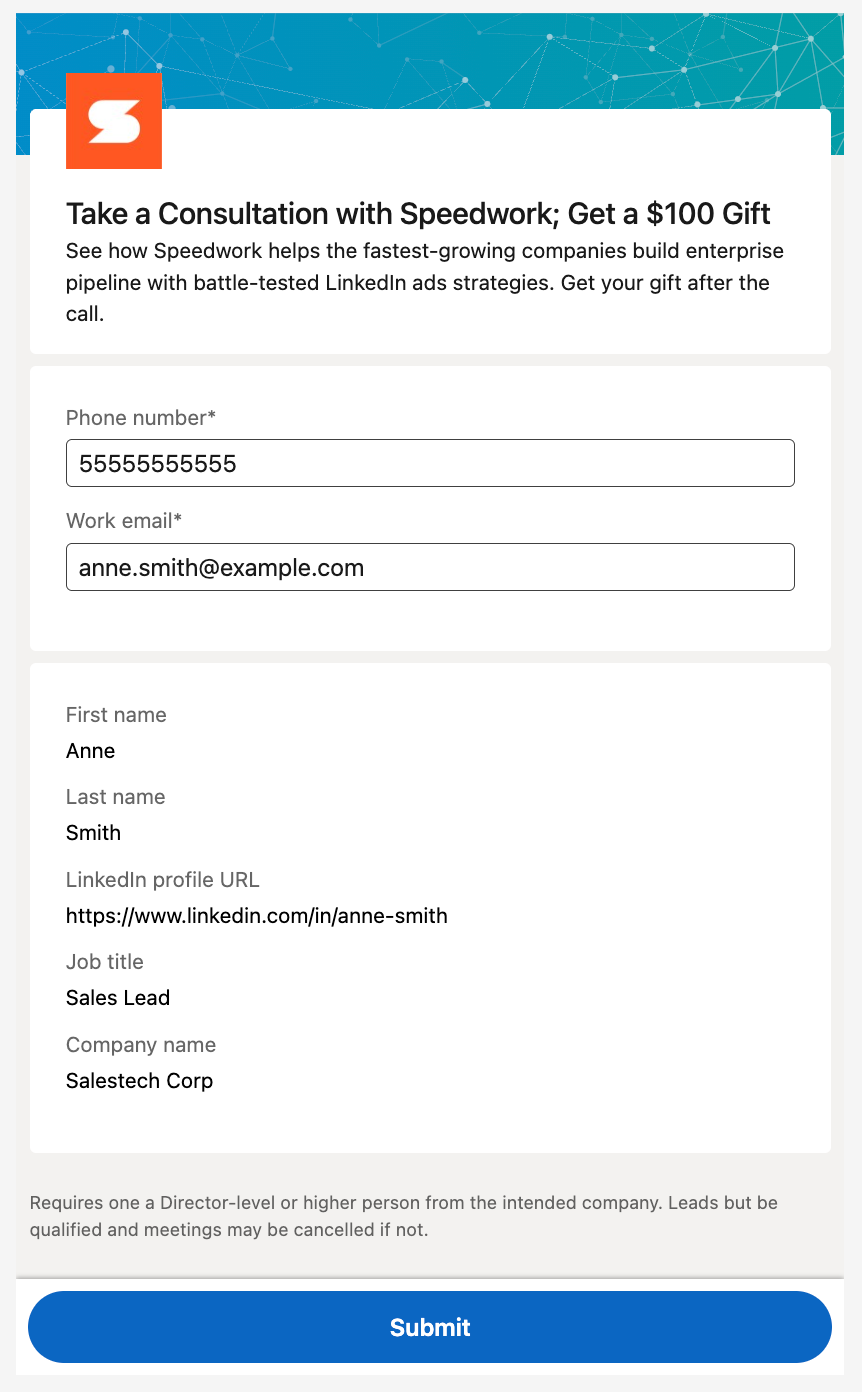
Send them straight to your calendar. Set the lead form’s destination URL to your calendar booking page, like Calendly, Chili Piper, or HubSpot Meetings, so prospects can book the demo themselves while they’re still interested. One catch: LinkedIn doesn’t currently let a Message Ad’s lead form redirect straight into a Calendly booking flow. Instead, use the form’s standard destination URL and point it at your Calendly or booking page. You can also add more qualifying questions on the booking page, like team size, budget, or timeline, without making the LinkedIn form any longer.
Step 6: Put the terms in the Message Ad footer
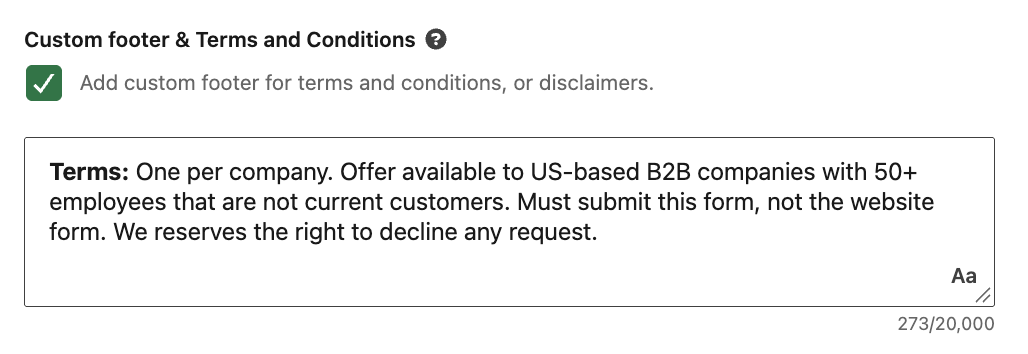
Message Ads include an optional terms and conditions footer. Use it. It sets expectations up front and gives your sales team something to point to when they decline a bad fit.
Typical terms include: one gift card per company, sent after a completed demo, offer limited to companies that meet your criteria, and the right to decline any request. Have your legal team review the final wording.
Watch out for industries that can’t accept gifts
Some industries and employers don’t allow employees to accept gifts at all, or cap their value. Government and public sector, healthcare, and financial services commonly have rules like this. If your buyers work in those industries, incentivized demos may not work for you. Offer a charity donation instead, or exclude those audiences from the campaign.
Step 7: Protect yourself from gift card hunters
Every incentivized offer attracts people who just want the reward. The most common trick: people scrape your ads from the LinkedIn Ad Library, then submit the demo form on your main website to claim the gift card.
The fix is simple. Only honor leads that come through the real LinkedIn Lead Gen Form attached to your campaign. If someone claims the offer through your website or by email, they didn’t come from the targeted audience, so the offer doesn’t apply.
Other red flags to watch for:
- Personal email addresses on a business form (require work email)
- Job titles or companies that don’t match your targeting
- People outside the geographic targeting you have set
- The same person submitting more than once
- Reluctance to join on a video call
Step 8: Politely decline bad fits before the meeting
Review every lead before the demo is booked. If someone isn’t a fit, decline as soon as possible, kindly and clearly. Don’t let a bad fit show up to a 30-minute demo and then decline the gift card afterward. That’s a worse experience for everyone.
A quick, polite “this offer is for teams that meet a few specific criteria” email keeps your brand intact and your sales team’s calendar clean.
Step 9: Only send the gift card after the demo
Always deliver the reward after the meeting is complete, never at booking. It protects your budget from no-shows and keeps the incentive tied to the actual conversation. Send it within a few business days so the experience stays positive.
Step 10: Set up your sales team to win the meeting
The ad gets the meeting. Sales has to make it count.
- Follow up fast. Most prospects will book themselves, but call anyone who submits the form without booking a time. You have their phone number, so reach out within hours, not days.
- Run a real discovery call, not a canned pitch. These buyers are curious, not committed.
- Make the goal of the call the next step, whether that’s a trial, a discovery call, or an assessment. Aim for more than 20% of incentivized meetings converting to that next step, otherwise that’s a sign that it’s not working.
- Tag the lead source in your CRM so you can track pipeline from these campaigns separately.
- Measure on pipeline, not cost per lead. A $400 meeting that turns into a $60,000 deal is a great deal.
- Capture what you learn about the account. Even when a meeting doesn’t become an opportunity, log who you met, who else is involved, and how the decision gets made. On enterprise accounts, that map is valuable on its own.
Copy templates
Two Message Ad templates to start with. Swap in your own problem, proof point, and offer. The highlighted parts are what you fill in.
TEMPLATE 1: PROBLEM, BENEFITS, INCENTIVE (OUR FAVORITE)
Subject: I may have a $100 Amazon gift card for you
Hey %FIRSTNAME%,
[One sentence on the problem your buyer is dealing with.]
Did you know that [product] can:
- [Function or benefit 1]
- [Function or benefit 2]
- [Function or benefit 3]
We’ll even throw in a $100 Amazon gift card for your time.
CTA button: Get a Demo
TEMPLATE 2: OFFER FIRST
Subject: Invite to [see product / event name] + A Gift
Hi %FIRSTNAME%, I’d like to send you a $100 Amazon gift card for 30 minutes of your time.
On the call, I’ll show you how [type of company] use [product] to [result], and what it could look like for [company].
Worth a quick chat?
FOOTER TERMS (PAIR WITH EITHER TEMPLATE)
One gift card per company, sent after a completed 30-minute demo. Offer limited to [ICP criteria]. [Company] may decline any request. Not available where prohibited by law or employer policy.
Incentivized demo ads checklist
- Warm audience selected (retargeting, engaged accounts, or a target account list)
- Bad fits excluded, Audience Expansion and Audience Network off
- One-to-one Message Ad with the offer in the subject line, backed by brand awareness campaigns
- Copy under 200 words with one clear ask
- Lead Gen Form requires a phone number plus one qualifying question
- Terms in the Message Ad footer, reviewed by legal
- Only LinkedIn form submissions honored
- Every lead reviewed, bad fits declined before booking
- Warm, friendly sender chosen (and tested)
- Gift card sent after the demo, within a few business days
- Lead source tagged, success measured on pipeline
- 20%+ of meetings converting to the next step (trial, discovery, or assessment)
Frequently asked questions
Do incentivized demo ads work on LinkedIn?
Yes, when they’re aimed at warm accounts and used by companies with high contract values or high close rates. In our accounts, incentivized demo campaigns have generated 41x to 50x pipeline-to-spend ratios. But they can fail when the targeting is too broad.
How much should the gift card be?
$100 is the most common amount and a strong starting point. If you’re targeting executives at large or premium companies, test $175, $250, or more.
Won’t people just take the gift card and leave?
Some will try. That’s why you target warm audiences, require a phone number, review every lead, decline bad fits before booking, and only send the gift card after the demo is complete.
Will incentivized demo ads hurt our brand?
Not when they’re run correctly. Send the offer only through one-to-one Message Ads, so it never appears publicly in the feed, and pair it with a strong brand awareness program so prospects already know you when the offer arrives.
Are there any rules to watch out for?
Review LinkedIn’s advertising policies and have your legal team approve your terms. Some industries, commonly government, healthcare, and financial services, restrict employees from accepting gifts, so incentivized demos may not work there. Offer a charity donation alternative or exclude those audiences.
Want help running incentivized demo ads?
Incentivized demo ads are one of the fastest ways to turn warm LinkedIn engagement into pipeline, but only with tight targeting, a qualification process, and a sales team ready to move fast.
Speedwork Social is a LinkedIn ads agency that plans, builds, and manages incentivized demo campaigns for B2B companies. Book a free consultation to talk through whether they’re a fit for you. Or start with a free LinkedIn Ads audit of your account.