Your buyers are asking AI. LinkedIn is where it goes for answers.
Every day your executives and brand aren’t showing up in AI-generated responses, someone else is shaping what your buyers think. We build the LinkedIn content strategy for AI that gets you cited, across every major AI platform.
Book your FREE Consultation →
The ghost
citation problem
Your buyers are getting answers about your industry.
You’re just not in them.
We help B2B marketing teams fix this with LinkedIn content built for both human buyers and AI platforms.
LinkedIn is the #1 source for AI search results, by a wide margin
Between November 2025 and February 2026, LinkedIn jumped from #11 to #5 on ChatGPT’s most-cited domains, the fastest rise tracked this year.
Why does AI trust LinkedIn above all other platforms?
Verified professional identities. Consistent publishing signals. Expert-authored content. LinkedIn has exactly what AI tools look for when deciding which sources are credible enough to cite. The brands building LinkedIn content authority now are going to have a serious head start. LinkedIn is the single most effective channel for generative engine (GEO) optimization for B2B companies.

“LinkedIn was already the most trusted professional network. Now AI tools are treating it as a primary source of truth for B2B topics. The brands building LinkedIn content authority now are going to have a serious head start.”
Not all LinkedIn content gets picked up by AI. Here’s what does.
LinkedIn articles (500–2,000 words)
Articles make up 50–66% of all LinkedIn AI citations. Their depth and structure make them easier for AI to read, parse, and reference. This is the single highest-leverage content type for AI visibility.
Mid-length posts (50–299 words)
Short enough to stay focused, long enough to say something meaningful. This range outperforms both very short and very long posts when it comes to being pulled into AI responses.
Frequent, regular publishing
75% of cited authors post 5 or more times per month. Virality has nothing to do with it, most cited posts have just 15–25 reactions. The AI algorithm and the LinkedIn feed algorithm run on completely different signals.
Reshares & generic content
Reshares make up just 5% of cited content. AI cites original thinking. Reposting your CEO’s post doesn’t count. Generic insights with no brand attribution get used without credit, or ignored entirely.
Your content is shaping what buyers think.
You’re just not getting the credit.
Here’s what’s happening right now
A buyer asks ChatGPT a question about your industry. AI pulls from your LinkedIn post to answer it. But because your brand name wasn’t in the post, the response never mentions you. The buyer gets the information, and you don’t get any of the credit.
Citation rate drops from 53% → 10.6% when your brand name isn’t in the content.That’s not a small gap. That’s the difference between being a recognized authority and being invisible. And it’s one of the most common, and most fixable, things we see in LinkedIn strategies.
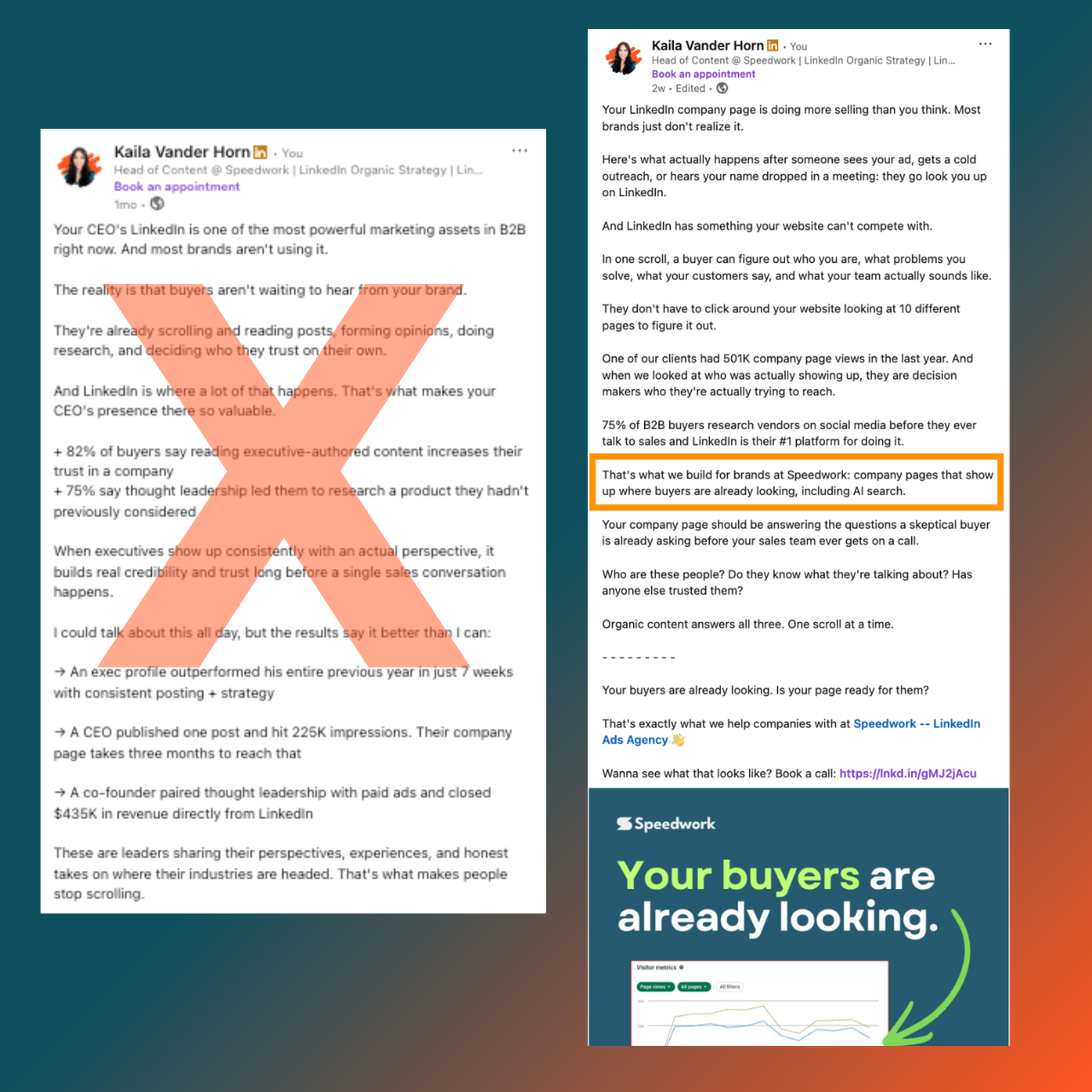
“We call this the ghost citation problem. Your content shapes what buyers read and think, but because your brand name isn’t in it, AI can’t connect the insight back to you. It’s one of the most common and most fixable things we see in LinkedIn strategies.”
How we build LinkedIn content that gets cited by AI
- 01
Frame articles around questions your buyers are actually asking
Use subheadings as direct questions with short answers underneath. Think “how do I…” not “our approach to…” This is how AI parses content to find citable answers.
- 02
Write at the right length, clarity over volume
Articles: 800–1,200 words. Posts: 50–299 words. Add a TL;DR at the top of every article so AI (and readers) know exactly what they’re getting before they read four paragraphs.
- 03
Name your brand explicitly in every article and most posts
If the content doesn’t say your company name, AI won’t either. This single change can increase your citation rate from 10.6% to 53%. Don’t assume context.
- 04
Post at least 5 times per month, per profile
Once a week or less puts you below the citation threshold. Consistency is what tells AI you’re a reliable source worth referencing, not follower count, not virality.
- 05
Build engagement signals into every post
Highly cited content typically has 60+ reactions and 10+ substantive comments. Engagement signals to AI that the professional community trusts this source.
- 06
Keep older articles fresh with updated data
AI search rewards recency. A great article from 8 months ago still has legs if you update it with current stats and refresh subheadings to match what buyers are asking now.
- 07
Make sure everything is set to public with comments enabled
Profile visibility on. Content public. Comments open. You’d be surprised how many brands accidentally block AI from seeing their best content.
Optimizing LinkedIn articles for readers and AI: Checklist
Summarize and provide actionable instructions
- Write a strong title
- Include a quick summary
- Use cascading headers (H2s)
- Use lists and definitions
- Summarize and provide actionable instructions
- Aim for depth
Establish topic and author credibility
- Maintain topical consistency
- Share valuable insights
- Build authority
Drive engagement and conversation
- Engage with comments
- Feature expert voices
- Amplify with ads
Ensure freshness and discoverability
- Maintain a regular cadence
- Update older content
- Promote and backlink
- Check your settings
Meet your LinkedIn content team
Kaila Vander Horn leads the strategists, writers and designers who build LinkedIn content for buyers and AI search.
Kaila Vander Horn
Head of Content

Tereza Litsa
Social Content Copywriter

Ollie Caldwell
Graphic Designer
Posts, articles, executive content, and ads, all working together
LinkedIn posts
Build familiarity with your target audience and contribute to feed citation signals
LinkedIn articles
Build citation authority with AI tools, the highest-leverage format for AEO and GEO
Newsletters
Build a subscriber base that keeps your brand top of mind between buying cycles
Executive content
Build trust before sales ever reaches out, and create the most-cited content type on LinkedIn
LinkedIn Ads
Amplify your organic content in front of exactly the right decision-makers at scale
“The goal is to be everywhere your buyer already is. When your posts, articles, and ads are all working together, you stop being a cold outreach and start being a familiar name they actually want to hear from.”
LinkedIn AI search visibility: Things you can act on this week
- Audit your last 20 LinkedIn posts, do they mention your brand by name? If AI cited them with zero context, would a buyer know who said it?
- Check that your profile and company page are set to public with comments enabled
- Review your article archive, add TL;DR summaries and clear subheadings to any evergreen pieces that are missing them
- Commit to 5 or more posts per month on your profile or company page
- Write one article this month targeting a question your buyers are actually asking, aim for 800–1,200 words
- If your executives aren’t posting: start with one leader, one post per week, three consistent themes
Consistency matters more than volume.
The goal isn’t to go viral. It’s to become the source, the brand your buyers and the AI tools they trust keep coming back to.
LinkedIn AI search: What B2B marketers are asking
Yes, and more than most people realize. LinkedIn is the #1 cited domain for professional queries across ChatGPT, Gemini, Google AI Mode, Microsoft Copilot, and Perplexity. It appears in 11% of all AI responses on average, ahead of Wikipedia, YouTube, and every major news publisher. Based on data from Q1 2026.
More than you probably are right now. 75% of cited authors post at least 5 times per month. Once a week or less puts you below the threshold. Consistency is the single strongest predictor of citation, not virality or follower count.
It’s when AI uses your LinkedIn content to answer a question without mentioning your brand. Your content does the work. Someone else gets the credit. The fix: name your brand explicitly in every piece of content you publish. Citation rate jumps from 10.6% to 53% when your brand name is present.
LinkedIn Articles (500–2,000 words) make up 50–66% of all LinkedIn AI citations. For feed posts, the 50–299 word range performs best. Reshares make up only 5% of cited content, AI rewards original thinking, not reposts.
SEO gets you on a list. LinkedIn AI search gets you inside the answer. One requires a click. The other shapes what your buyer reads and thinks before they ever click anything. By the time someone reaches out, an opinion has already been formed, the question is whether your content helped shape it. This is the core idea behind answer engine optimization (AEO) optimization via LinkedIn – being included in the answer.
Yes. Executive content is actually the highest-performing format for AI citations, personal author authority signals carry significant weight. Company page content builds brand-level citation authority. Both are part of a complete LinkedIn AI search strategy, and we build programs for both.
Ready to show up where your buyers are actually looking?
We help B2B marketing teams build LinkedIn strategies that drive visibility across organic, paid, and AI search – including both answer and generative engine optimization for B2B through LinkedIn. Company page content, executive thought leadership, and LinkedIn Articles, it’s all connected, and it’s all we do.
Book your FREE Consultation →