TL;DR
- LinkedIn is the top B2B ad platform and it rewards teams who actually know how to run it well.
- In-house works when you have dedicated paid media talent, time to build the systems, and tight sales and marketing alignment.
- An agency works when you need speed, SaaS-specific expertise, and a full-funnel strategy without the ramp up phase.
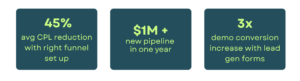
- The gap in results is real. The right setup, run well, can cut CPL by 45% and triple demo conversions.
- The decision comes down to your team’s current capacity, your growth timeline, and how much you can afford to learn on the job.
Trying to decide whether to run LinkedIn Ads in-house or hand them off to an agency?
It’s definitely a more loaded question than it sounds.
If you’re growing a SaaS business, LinkedIn is one of the few channels where you can actually reach the people who control the budget, sign off on contracts, and book the demos.
And once you’ve decided LinkedIn is worth investing in, the next question comes up fast: who’s actually running it?
The answer depends on where your business is right now.
So let’s get into the real tradeoffs: what each option costs, where expertise gaps tend to show up, and what kind of results you can realistically expect from both.
Why are LinkedIn Ads Worth It?
Before getting into the who, it helps to understand the why.
For SaaS companies, LinkedIn consistently delivers access to the right buyers. The caveat is that the results are only as good as the execution behind them.
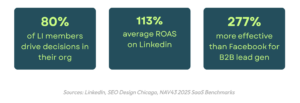
The platform works but the question is whether your current setup is equipped to make it work for you.
And, that’s where the in-house vs. agency decision comes in.
What the B2B Buying Journey Means for Your LinkedIn Strategy
B2B buyers read, compare, and loop in half their org before anything close to a decision gets made.
By the time someone fills out a form, the opinion is mostly already formed. The buying journey is not a straight line. Matter a fact, It’s not even a squiggly line.
It’s a coworker venting about a problem, an exec forwarding a report, a podcast recommendation, a Slack mention, a G2 check, and somewhere in the middle of all that, your LinkedIn ad.
Attribution software catches maybe two of those moments. A good strategy is built for all of them.
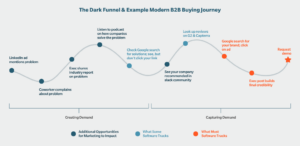
The Dark Funnel and Example Modern B2B Buying Journey, Adapted from Summit Partners, used with modifications.
What a Full-Funnel LinkedIn Strategy Actually Looks Like
LinkedIn Ads for SaaS works because of what happens between the first impression and the demo request. That space is bigger than most people think.
A full-funnel setup means cold audiences are hearing about you for the first time, warm audiences are getting reasons to trust you, and high-intent audiences are getting a clear reason to take action.
Everyone gets the right message at the right moment, not the same message blasted at everyone and hoped for the best.
Each stage has a specific job. The messaging is written for where that person actually is, not where you wish they were.
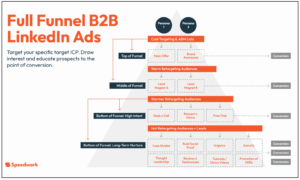
For a deeper look at what a high-performing LinkedIn Ads program looks like for SaaS, here’s how Speedwork builds LinkedIn lead generation funnels from first impression all the way to demo.
This is the architecture that needs to exist regardless of who runs it. The question is who has the experience to build it, optimize it, and keep it performing over time.
The Case for Keeping It In-House
Running LinkedIn Ads internally keeps you close to the things that are hardest to hand off: your brand voice, your creative instincts, and the day-to-day conversations happening between marketing, sales, and product. That kind of proximity has real value.
It works especially well when you already have a dedicated demand gen or paid media person on staff and the team has actual bandwidth to build something properly. Not “we’ll figure it out” bandwidth… Real bandwidth.
The honest part nobody loves to say out loud: hiring strong paid media talent takes way longer than most teams expect.
And even after you find the right person, internal priorities have a funny way of showing up uninvited.
Campaigns need consistent attention to keep performing, and that attention is usually the first thing to get sacrificed when Q3 gets busy, for example.
The Case for Working With a SaaS LinkedIn Ads Agency
Bringing in a SaaS-focused agency means skipping the ramp-up period and plugging directly into a team that already knows the platform, the ins and outs, and what actually converts. No fumbling around and expensive trial and error.
It tends to be the right fit when you need to move fast and can’t afford a six-month learning curve, your team is lean or newer to paid growth, or you want someone who actually thinks about pipeline.
A good agency also brings something that is genuinely hard to replicate internally: cross-client data.
When a team has run hundreds of SaaS campaigns across dozens of companies, they have seen what works, what flops, and where budgets go to die.
They know what benchmarks actually look like for your stage and motion, what is worth testing versus what sounds interesting but never converts, and where most teams are quietly bleeding spend without realizing it.
That pattern recognition is hard to put a price on but it shows up fast in the results.
Worth knowing: LinkedIn Lead Gen Forms convert at 13% on average compared to 2.35% for external landing pages, the kind of platform-specific insight that separates an experienced team from someone figuring it out as they go.
What to Actually Look For in a SaaS LinkedIn Ads Agency
Finding the right agency comes down to a few things that are easy to overlook in the evaluation process.
With CPLs on LinkedIn regularly exceeding $100 for B2B tech companies, the details matter a lot.
- Proven SaaS experience. Real case studies with specific pipeline numbers and context that matches your stage and go-to-market motion. The more their past work looks like your situation, the faster things move.
- Full-funnel thinking. The conversation should start at MQL and go all the way to Opportunity. LinkedIn can deliver between 2.44x and 6.01x pipeline ROI for SaaS companies, but that range depends heavily on how well the strategy maps to the full revenue cycle.
- Format expertise. Document Ads convert at 22.73% while video comes in at 2.26%. This is the kind of gap that only becomes obvious after running hundreds of campaigns across different accounts and industries.
- CRM and lead scoring integration. Every lead should flow directly into your sales process, scored and handed off with the context your team needs to actually work it.
- Pipeline-first reporting. CPL is a starting point. Demo conversions, revenue influenced, and pipeline created are the numbers worth building your reporting around.
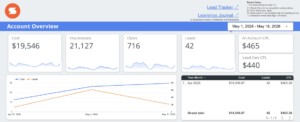
High CPCs, Low-Quality Leads, and What We Did About It
Case #1
Findem is a powerful AI-driven talent platform serving SaaS and HR teams.
They came to Speedwork after running campaigns on their own: CPCs were high, cost per conversion was climbing, and the leads coming through weren’t matching their ICP.
We rebuilt their LinkedIn strategy from the ground up with a full-funnel approach across brand awareness, lead generation, retargeting, and ABM account penetration.
The strategy covered social media, ABM targeting, brand awareness, lead generation, retargeting, demos and consultations, and nurture for working opportunities.
The result: over $1M in new pipeline opportunities in the first year.
Case #2
RepTrak is the world’s largest reputation intelligence platform, helping global brands understand how stakeholders perceive them across reputation, brand, ESG, and media impact.
They came to Speedwork running campaigns for their yearly report, but the numbers weren’t working. Cost per conversion was high and inbound leads were coming in below expectations.
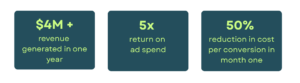
We rebuilt their LinkedIn strategy with more precise audience targeting, stronger ad creative, and cost optimization techniques that started showing results within the first month.
From there, we expanded into a full-funnel approach covering social media, ABM targeting, industry segmentation, global campaigns, lead generation, and retargeting.
The result: over $4M in revenue at a 5x ROAS in a single year.
So, Which One Is Right for You?
It comes down to your goals, your team’s capacity, and how fast you need to move. Teams with the right people and bandwidth do great work in-house.
Teams that need speed, scale, or a strategic partner get there faster with an agency, and with less risk.
If you’re still figuring out what makes sense for you, Speedwork offers free consultations.
We have spent over 10 years building LinkedIn programs for B2B SaaS companies at every stage of growth. With more than $100M in ad spend and 565,000 leads generated, we know what works on LinkedIn for SaaS.
If you’re ready to move past ad-hoc campaigns and build something that actually ties to pipeline, a free strategy call is the place to start. Book a free strategy session with Speedwork.
Before You Decide: A Quick Readiness Checklist
In-house might be the right fit if:
- You have a dedicated demand gen or paid media hire with LinkedIn experience
- Your marketing and sales teams are closely aligned
- You have the bandwidth to build and optimize campaigns consistently
- You can absorb a 90-day ramp-up period before drawing conclusions
An agency might be the right fit if:
- You need to move fast and can’t afford a six-month learning curve
- Your team is lean or newer to paid growth
- You want full-funnel strategy, not just campaign execution
- You need reporting that connects ad spend to pipeline, not just platform metrics
Either way, ask yourself:
- Do we have clear ICP targeting and a defined offer for each funnel stage?
- Is our CRM set up to receive, score, and route leads from LinkedIn?
- Do we know our CPL ceiling relative to our ACV?
- Are we prepared to commit at least $5,000 to $10,000 per month to generate meaningful data?
FAQ:
How much should a SaaS company budget for LinkedIn Ads?
Most SaaS teams need at least $5,000 to $10,000 per month to generate meaningful data and results. CPL for Software and IT companies averages around $125, so anything below that threshold makes it hard to run proper tests and optimize toward pipeline. The more important number is your customer acquisition cost ceiling relative to deal size. A $150 CPL against a $50K ACV is very workable. Against a $5K ACV, the math gets tighter.
How long does it take to see results from LinkedIn Ads?
Realistically, plan for 90 days before drawing conclusions. LinkedIn’s buying cycle is longer than most paid channels and early ROAS numbers tend to look flat. The benchmark data shows real performance showing up at the 180-day mark, with top-performing programs hitting 1.5 to 3x ROAS by that point. Teams that judge LinkedIn too early almost always underinvest right before it starts working.
What’s the difference between a general agency and a SaaS-specific LinkedIn Ads agency?
A general agency knows the platform. A SaaS-specific agency knows your buyer, your funnel, your sales cycle, and how to connect campaign performance to CRM outcomes. That difference shows up in targeting decisions, creative strategy, offer structure, and how they define success. Impressions and clicks are not pipeline. A SaaS-focused agency knows that going in.
Is it worth using LinkedIn Lead Gen Forms instead of sending traffic to a landing page?
Almost always, yes. LinkedIn Lead Gen Forms convert at around 13% on average compared to 2.35% for external landing pages. They also reduce CPL by 30 to 50% in most cases. The tradeoff is that lead quality can vary more at the top of funnel, so pairing them with strong qualification criteria and good CRM integration matters a lot.
Can I start in-house and move to an agency later?
Absolutely. A lot of SaaS teams start in-house to learn the platform and build foundational assets, then bring in an agency once they’re ready to scale seriously. The key is not waiting too long. Every month of suboptimal campaigns has a real cost in budget and pipeline, so the transition is worth making earlier than most teams expect.
How do I know if my current LinkedIn Ads are actually working?
Stop looking at CTR and impressions as the main measure. The metrics that matter are CPL, demo conversion rate, MQL to SQL rate, and influenced pipeline. If your reporting doesn’t connect ad spend to actual sales outcomes, you’re measuring activity, not results. A good agency should be showing you pipeline impact, not just platform performance.