If you’re running LinkedIn Ads for your B2B SaaS company and seeing a lot of clicks, but not many leads or demos, you’re not alone. That conversion gap is one of the most common frustrations for SaaS marketers.
Impressions and CTR might look good on paper, but they don’t move pipeline. The goal is conversions: form fills, demo bookings, trial signups. To improve performance, you need to focus on what actually drives action and LinkedIn Conversation Ads are one of the most underutilized tools for doing exactly that.
In this guide, we’ll cover real benchmarks, proven message structures, and optimization tactics to help you raise your LinkedIn ad conversion rates, particularly when using conversation ads on LinkedIn.
What Is a Good LinkedIn Ad Conversion Rate for SaaS?
Across industries, the average conversion rate for LinkedIn ads (from click to form submission) ranges between 6–10%, according to LinkedIn Business data.
But in SaaS, especially with high-ticket B2B models, expect different benchmarks:
- Top-funnel offers (e.g., content downloads): 10–15% conversion
- Demo requests or trials (mid/bottom funnel): 3–7%
- Conversation Ads with CTA buttons: 40%-54%% (but you have to get the open first!)
Your audience’s awareness level, offer type, and funnel stage will significantly affect your average conversion rate on LinkedIn ads.
Learn more here about why LinkedIn Ads work for B2B lead generation.
Why Conversation Ads Work for SaaS
Conversation Ads on LinkedIn are a direct, inbox-based format that mimics warm outreach. They combine messaging’s open-rate advantage with the structure of email nurturing, plus clickable CTAs to guide engagement.
They’re especially powerful when used for:
- Mid-funnel re-engagement (e.g., follow-up after a guide download)
Bottom-funnel CTA offers (e.g., “Book your free strategy call”) - Segmentation-based personalization (e.g., different flows for Marketing vs. Product roles)
Unlike static ads, LinkedIn conversation ads feel personal and timely, great for B2B buyers who are juggling lots of noise.
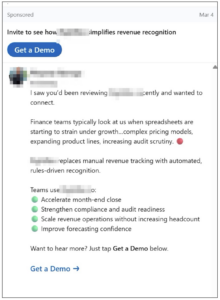
Anatomy of a High-Converting LinkedIn Conversation Ad
Here’s what separates an average conversation ad on LinkedIn from a high-performing one:
Subject Line
This is your open rate driver. Keep it curiosity-driven or benefit-first.
Example: “Quick Q: Want to see how we reduced churn by 32%?”
Message Structure
- Line 1: Acknowledge their role or pain point
- Line 2: Present a simple, specific value
- Line 3: Give two CTA options (e.g., “Yes, show me” / “Send a case study”)
CTA Buttons
Use interactive choices. Avoid “Learn More”—be specific:
- “Book My Demo”
- “Download the Guide”
- “Chat With a Specialist”
Visuals
Optional. Test with/without. In SaaS, text often outperforms images unless you’re showcasing product UI.
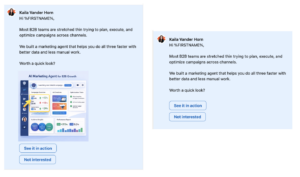
Common Mistakes That Kill Conversion Rates
Want to know why your CPL is climbing? You might be making one of these avoidable mistakes:
- Asking for too much too soon (e.g., “Book a 30-min call” from a cold lead)
- Using vague or generic CTAs
- Running the same message to all audience segments
Neglecting lead gen form design (too many fields, unclear value)
Good conversation ads are relevant, respectful of time, and valuable up front.
Check out our recent blog on the top mistakes SaaS companies make with LinkedIn Ads (and how to avoid them).
Optimization Tactics to Boost Results
Want to increase your LinkedIn ad conversion rates this quarter? Try these tested optimizations:
- Split test subject lines weekly – this affects open rates more than copy
- Segment messages by persona (e.g., different messages for founders vs. operations leads)
- Use Lead Gen Forms inside the ad flow to reduce friction
- Retarget users who clicked but didn’t complete the form or booked demo
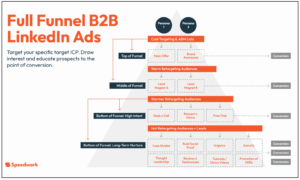
Stay up-to-date with LinkedIn Ads benchmarks.
Bonus Strategy: Conversation Ads as a Nurture Sequence
Don’t rely on one-shot ads. SaaS sales can take a long time, so be sure to retarget and nurture your prospects, and give them all of the information they need to be interested in moving forward.
With conversation ads, you can create chat flow trees, in a “choose your own adventure” style of interaction.
- Ad Message 1 – What problem do you have?: Ask the prospect to click and choose which problem they’re dealing with, and you can serve up a relevant response.
- Ad Message 2 – What solution are you looking for?: Offer a few different solutions based on your features.
- Ad Message 3 – Offer multiple CTAs: Not everyone is ready to schedule a call, so consider offering multiple CTAs such as a free trial or interactive demo.
Align this flow with talking points from your sales team to maximize conversion.
Conclusion
If you’re running paid campaigns on LinkedIn, improving your LinkedIn ad conversion rates doesn’t require a complete overhaul; it requires smarter messaging, better targeting, and strategic sequencing.
Conversation ads on LinkedIn can be your most cost-effective path to qualified demos if you:
- Segment audiences properly
- Use value-first CTAs
- Offer multiple pathways and CTAs
Want expert eyes on your ad performance?
Book a free LinkedIn Ad performance audit with Speedwork to get practical insights you can implement immediately.